Licensed Applications That Stop Weed Pressure at the Source
Weed Control Services in Timpson for rural acreage, large lawn areas, and property perimeters with persistent broadleaf and grass weed problems
Managing weed pressure across a rural East Texas property is a different scope of work than treating a quarter-acre suburban lawn—acreage lots, pasture perimeters, and large turf areas require licensed chemical applications that go well beyond what over-the-counter products can sustain across the growing season. Twisted Pines Outdoor Solutions holds a weed control license and integrates treatment directly into lawn maintenance and mowing packages for properties in Timpson, which means applications happen on the same visit cycle as regular maintenance rather than requiring a separate appointment. The business is family-owned and operated by a former landscape company owner with 35 years of field experience managing large-scale turf programs across a 9,000-customer operation.
Licensed weed control is applied during the standard maintenance cycle according to site conditions and current weed pressure—meaning treatment timing is based on what is actually happening at the property rather than a fixed calendar interval. This matters for rural properties because weed pressure is rarely uniform: pasture edges, fence lines, and drainage corridors often carry heavier broadleaf or grass weed loads than the maintained turf area, and those zones require targeted attention that a blanket schedule misses. Folding weed control into the mowing package eliminates the coordination gap where weeds get ahead of treatment because a separate service was delayed.
Set up a maintenance and weed control consultation to review site conditions and identify the zones carrying the heaviest weed pressure on your property.
What Licensed Weed Control Actually Requires on Site
State licensing for weed control exists because the products used in commercial applications are categorically different from retail herbicides in concentration, selectivity, and regulatory handling requirements. A licensed applicator is trained to distinguish between broadleaf weeds, grassy weeds, and sedges—which each require different chemical families to control effectively—and to apply products in a manner that avoids drift, contamination of adjacent areas, or unintended turf damage. The license Twisted Pines carries reflects that training and gives clients a compliance baseline that unlicensed operators cannot provide.
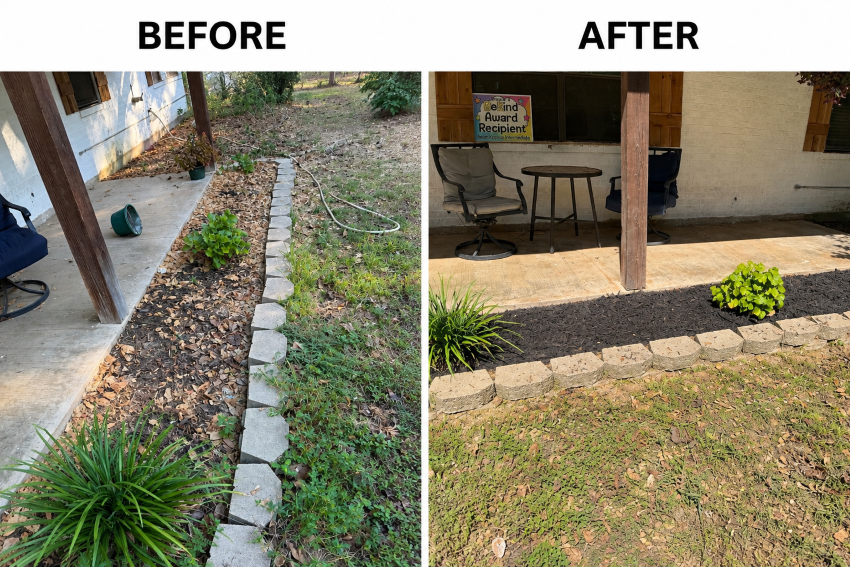
After treatment cycles are established and maintained properly, the change at the turf level is measurable: weed populations thin out progressively between visits rather than rebounding to the same density, desirable turf fills in where weeds previously competed for space, and property perimeters that previously required constant manual clearing hold cleaner for longer intervals. The improvement is not immediate after a single application—weed control works as a program, not a one-time reset—but it becomes visible within a few treatment cycles.
Because weed control is included in the lawn maintenance and mowing package rather than billed as a separate service line, there is no situation where a property goes multiple weeks between a mowing visit and a scheduled treatment—the two happen together, which is the most effective timing for maintaining turf health across properties with varying weed pressure zones.
Answers About How Weed Control Work Is Done
These questions address the weed control process itself—how applications are made, why licensing matters, and what clients observe as treatment cycles accumulate.
Why does weed control require a state license and what does that mean for the application?
Licensed applicators are trained and tested on product selection, application rates, drift prevention, and site-specific safety requirements; using unlicensed commercial herbicide application exposes a property owner to liability and often results in misapplied products that damage turf or fail to control the target species.
How is the correct herbicide selected for the weeds present on a specific property?
Treatment selection depends on identifying whether the problem weeds are broadleaf species, grassy weeds, or sedges—each category requires a chemically distinct product family, and applying the wrong type does not affect the target species while potentially suppressing the desirable turf around it.
What does integrating weed control into the mowing cycle actually accomplish?
Treating during the same visit as mowing means applications happen at consistent intervals tied to active turf growth, which is when selective herbicides are most effective—weeds in active growth stages absorb and translocate the product more efficiently than dormant or stressed plants.
How does weed pressure on rural Timpson-area acreage differ from standard residential lawn treatment?
Large rural properties typically have fence lines, pasture edges, and drainage paths that carry persistent seed pressure into maintained turf areas; controlling those perimeter zones is part of what a site-specific program addresses that a fixed-schedule residential treatment does not.
What visible changes indicate that a weed control program is working correctly?
Weed density decreases progressively between visit cycles, bare patches left by dying weeds begin filling in with desirable turf, and perimeter zones that previously showed heavy broadleaf growth stay cleaner for longer intervals between applications.
Twisted Pines Outdoor Solutions can build a maintenance package around your property's specific turf area and weed pressure zones—contact the office to begin that assessment for your Timpson property. Twisted Pines Outdoor Solutions also provides licensed weed control services in Shelbyville, San Augustine, and Center.